

Tour Operators

Tourist attractions in Ecuador
 BuenTrip Travel APP
Address:
Lamar 24-90 y Francisco ParedesTourism businesses within 30 km.
Places to visit within 30 km.

The church and square of San Sebastian constitute the western limit of the Historical Center of Cuenca (World Cultural Heritage Site by UNESCO). They are the main points of the historic neighborhood of the same name, in the urban parish of San Sebastian. The San Sebastian neighborhood is traditionally full of popular trades: pottery, tailoring, carpentry, tile-making, buttonhole making, painting. Tourism has a remarkable development with hotels, restaurants and cafeterias installed in heritage houses. The charm of its church, the park and an intense cultural life due to the presence of the Museum of Modern Art are the main attractions. There are craft workshops such as the embossing workshop of the master Carlos Bustos, several craft shops and bakeries. Recently, in a corner of the park, there is a restaurant owned by a Cuenca-Belgian couple that offers beer produced in the town. Every year, on December 24th, the "Pase del Nino Viajero" (The Traveler Baby Jesus), a traditional parade celebrating the birth of Jesus, starts from San Sebastian. The church, on the outside, has a single tower that dominates the facade. This is an unusual feature in religious architecture. Its main door is made of carved wood, with reliefs of the Bible's testaments. A large dome also stands out in the structure of the church. The interior of the Catholic temple is divided into three naves, separated by wooden columns. The space is quite sober, without as much detail or decoration as in other similar buildings in the city of Cuenca. On the corner of a small square in front of the temple's facade, at the intersection of Calle Bolívar and Calle Coronel Tálbot, stands the Cross of San Sebastián. Formerly this cross was the mark of the end of the city and the departure point towards the west. There are news of the church and its corresponding sector since the first years of Cuenca's foundation. It was a hermitage or small church of Fabián and Sebastián, saints and martyrs. As the centuries passed, the name of Fabián was abandoned, leaving San Sebastián as a traditional "Indian parish". Racial and social separation established by the Spanish colonizers to name a place that concentrated humble but necessary trades for daily life. The San Sebastian park is located next to the church. It has an ornamental pool and an interesting variety of trees and plants. The park is ideal for short walks, to rest and breathe fresh air. In its centre is the bust of the poet Miguel Moreno. In front of the park, on the opposite side of the church, is the Museum of Modern Art. Two historical events took place in San Sebastian Park. The first was the murder of the doctor Juan Seniergues, a member of the French Geodesic Mission (a scientific mission to measure Earth’s circumference), in 1739, during a bullfight. The second event are the first football matches in Cuenca, which were played there at the beginning of the 20th century. The geometric layout of the square, which has Renaissance influence with parterre gardens in the Versailles style, is attributed to Octavio Cordero Palacios.
1.15 Km.

The beer culture of Belgium has its sanctuary in Cuenca, Ecuador. A small establishment in the San Sebastian Park, is cozy and ideal for a refreshing beer or fast food: "Jodoco Belgian Bistro". The place is the result of a dream. The Ecuadorian-Belgian couple formed by Paola and Carlos arrived in Cuenca in 2012 and set up the tavern. They sell handcrafted beer made by the brand Derijcke Cerveceria following Belgian recipes. The name of the bistro and beer bar is a tribute to Fray Jodoco Ricke, a Franciscan religious of Flemish origin, founder of the Escuela Quiteña de arte. He built the Convent and Church of San Francisco, created the San Andrés School of Arts and Crafts and planted wheat for the first time in South America. He started the first brewery in Latin America. He arrived in Quito in December 1535. The traditional drink of Belgium is beer. Jodoco Bistro, located in a historical and pleasant environment, invites you to discover flavors and atmospheres from the other side of the Atlantic. Its tables are located overlooking the park and the church of San Sebastian. It is a bohemian place, with surprising culinary wonders: the cheese or meat tapas. San Sebastian Square is characterized by its tourist development with the Museum of Modern Art, the Larrazábal Gallery and service places such as restaurants and hotels. It also has a place in the history of Cuenca. In 1739 Jean Seniergues, a doctor from the French Geodesic Mission, was lynched there. In 1820, the patriots of Cuenca who rose up against Spanish rule on November 3rd retreated there. An artisan beer is brewed with its own recipe by a master brewer. That's why it has a different taste to the industrial one. Of limited production, it pays attention to flavors and textures. It does not contain artificial elements, the fermentation is natural and the flavors are the result of the mixture of water, malt, hops and yeast; fruits, spices and herbs can be added. Flavor combinations depend on consumer requirements. It offers quality, diversity and personal attention.
1.15 Km.

The Carlos Bustos Embossing Workshop is located in the urban parish of San Sebastian, just a few steps from the main square of the main historical sector of the city of Cuenca (UNESCO World Heritage Site). In this section of Coronel Tálbot Street it seems that time has stopped. Low houses, made of adobe (a clay-based building material), many of which remind us of the city of yesteryear. In this workshop, with the craft technique of embossing, they work on sheets of different types of soft metals, leather or other ductile raw materials, in order to achieve reproductions of images in relief. Carlos Bustos comes from a family of tinsmith artisans. His father and brother were dedicated to this trade. But he, 40 years ago, decided to go his own way. He was a student of the artist Edgar Carrasco, from whom he learned the basics of art and working with metals. When he gained experience, he decided to open his own workshop. The work begins with drawing what he wants to do. Then with his hands and a lot of care, he uses simple tools to do his job, such as screwdrivers transformed into profilers, hammers, brushes, rollers. An embosser resorts to the technique of the "negative", by means of which, with the forms drawn backwards of the plate of chosen material, that settles on a soft surface and little by little, by means of a progressive deformation of the worked surface, the relief is obtained. Finally, he turns the piece over and outlines the details to define the shapes. Bustos is a tireless creator and owner of infinite patience. In his workshop the most varied objects are exhibited, well decorated: crosses, paintings, masks, lamps, lanterns, candlesticks, animal figures, mirror frames, among others. His favorite materials, because of their low cost, are aluminum, brass and tin. The prices of his embossings vary according to the time it took him to make them and their size. The visitor can ask for a test of skill in this place: to make his own embossing. If you are in a hurry to visit Cuenca, you might miss this charming place. Attention to detail is necessary, as the workshop is small and can go unnoticed between the Museum of Modern Art and the staircase leading down to the Plaza del Otorongo.
1.18 Km.

The Municipal Museum of Modern Art (MMAM), has a prestigious and solid cultural background. It is located in the Historical Center of Cuenca (Ecuador), a UNESCO World Heritage city. The Museum temporarily exhibits modern art works by contemporary national and foreign artists. The rooms of the Museum are permanent headquarters of the International Art Biennial. Its reserve holds a large pictorial collection, which has been growing for 40 years. In addition, the Museum runs a program of activities and dissemination of art, dedicated to children, youth and older adults. The Museum was inaugurated on August 1, 1981. It was Hernán Crespo's initiative to recover the house from its destruction and restore it. The history of its use over the years is curious. Bishop Miguel León ordered its construction in the 19th century, as a refuge for alcoholics or "Casa de la Temperancia” (House of Temperance). It later served as a men's prison, nursing home, children's home, work school, and health center. The architecture of the building is old, with institutional purposes. Its doorway is in the neo-Gothic style. The interior is organized around an old chapel, in the center of the Museum. Around it there are several courtyards with portals. The chapel has a mural painting by Nicolás Vivar where a large painting with the parable of the prodigal son stands out. The First International Painting Biennial of Cuenca was inaugurated in 1987 in the Museum of Modern Art. It was conducted by Eudoxia Estrella, the first director of the MMAM. The Museum has an Art Reserve. It offers the service of workshops. The Information Office displays a collection of posters of the exhibitions held and the library specializes in art.
1.18 Km.
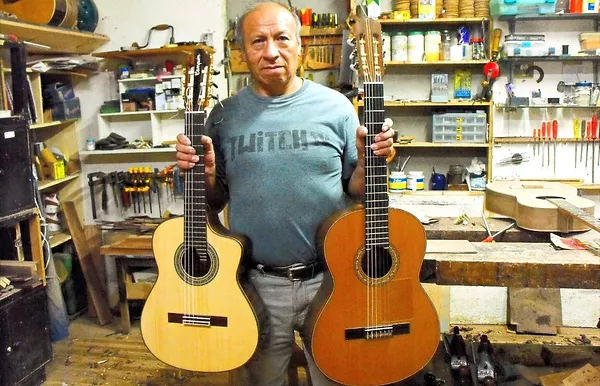
A prestigious brand of musical instruments is Uyaguari-Quezada. It has the support of the experience and professionalism of a family of luthiers, which for 4 generations has been dedicated to the construction mainly of the classic guitar. The ancestor of the Uyaguari family comes from the parish of San Bartolomé, "the cradle of guitars", in the canton of Sígsig. The artisan workshop is located in their house, Arquímedes street, Bellavista neighborhood, Cuenca. There, Luis Enrique and Pablo Andrés work together, making beautiful guitars. Pablo is the fourth generation of a family dedicated to the construction of stringed instruments. His father Luis, a craftsman since he was 13 years old, is the third of eight children of Julio Uyaguari, a native of the Sigsillano neighborhood. The "dynasty" would have started with Isidoro Uyaguari, Luis' grandfather. An anecdote tells that one day Isidoro disassembled a guitar to understand how it worked. That moment was the beginning of the family tradition. Art, passion, professionalism, tireless dedication, identity, creativity. These are the opinions of those who have visited the Uyaguari-Quezada workshop, describing their instruments as "authentic wooden jewels", delicate, subtle, moving. Although the Uyaguari specialty is classical guitars, they also make charangos, tiples, bandolas, bandolines. In other words, they are authentic luthiers in the original sense of the word. They use the most noble raw materials: capuli, cypress, teak and walnut. The sound of a guitar is defined by the soundboard. The two craftsmen dedicate more time to this piece, since the perfection of the instrument depends on it. Another skill that only gives the knowledge of the trade is the sensitivity through touch, to judge if a guitar is worth or not. Father and son are music lovers, the result of their work. They love Ecuadorian music, Cuban trova, the new Latin American song and rock. A luthier is a person who builds, adjusts or repairs stringed instruments such as guitars, cuatros or lutes. Today this name is extended to any artisan who repairs musical instruments in general, including wind and percussion instruments. A word of French and Arabic origin, meaning "wood".
1.25 Km.

San Roque, parish of Sucre. Special Area of the World Cultural Heritage of Cuenca. Neighborhood opposite El Vado. It is located on the right bank of the Tomebamba River. Old southern entrance to the city, along Loja Avenue and the ascent of the Barranco. The most important structures of San Roque are its church, dedicated to the devotion to the patron saint and the Virgin of Guadalupe, its square with the monument to General Antonio José de Sucre and the campus of the University of Cuenca. The image of the saint arrived in the 17th century brought by a priest. It was lost and reappeared in the 19th century. Thus the place acquired the name of the miraculous icon. On the bohemian side of this neighborhood, it is known by the name of San Draque. Draque is an alcoholic drink that reminds us of the pirate Drake. In the past, there were cantinas in San Roque. In the basement of their houses, drink smugglers hid the product from the authorities. At the beginning of the 20th century, it was a place full of quintas. Its nature, landscapes and proximity to the river were sources of romantic inspiration for musicians and poets. In Roberto Crespo Ordóñez's country house, the Lyre Festival was created in 1919. It is the setting for popular legends such as "The Headless Priest", "The Widow of the Lantern" and life stories such as that of the character "Paco Bermeo". Gastronomy adds another attraction to the neighbourhood. There are workshops for making Corpus Christi sweets, which are in great demand abroad, as well as cafeterias, barbecues, fast food, vegetarian and Manabitan food. There are 36 places in San Roque and Loja Avenue for traditional and typical food. There is a very special spot on Loja Avenue and Galapagos. There are at least 5 places where you can have and eat snacks among friends: coffee or chocolate with humitas or tamales, bolón de verde and empanada de verde. The most popular is called Aroma de Café.
1.41 Km.
Browse the tourism services available all over Ecuador.
Find the ideal city for your next trip and discover everything about it.
Find the main tourist attractions in the main cities of Ecuador.