

Tour Operators

Tourist attractions in Ecuador
 BuenTrip Travel APP
Address:
Av. Daniel Muñoz, BibliánTourism businesses within 30 km.
Places to visit within 30 km.

The Artisan Production Cooperative Puertas del Cielo (COPROARPU) is an organization of the Popular and Solidarity Economy (EPS) of Ecuador. It brings together 120 women weavers of hats, bags and toquilla straw handicrafts, 100% handmade, from the cantons of Azogues, Déleg and Biblián. COPROARPU has product lines for children, ladies and gentlemen. Its bags are woven with the techniques of crochet or needlework in various sizes, designs and colors. They also offer key rings, headbands, earrings and baskets. It is located in the headquarters of the Cañar Bar Association, Borrero parish, Azogues canton. The place has the machinery to process the hat: a masticating machine, metal moulds, blistering and dyeing tanks. The cooperative promotes the traditional weaving of Ecuadorian toquilla straw hats abroad, participating in international fairs. Their craftswomen are always willing to show their skills in public. Puertas del Cielo during 2017 exported 10.000 hats to European and South American markets. Monthly it produces between 500 to 1,000 hats. It sends products to the United States, Singapore, China, Russia and crocheted bags to Brazil. The results of the organization and community cooperation are the corporate image and brand "Azohat" whose motto is "hands weaving art", the website of the cooperative and the product catalogue. COPROARPU is committed to strengthening the social organization of the toquilla straw artisans associations. It wants to boost the tourist development of Azogues by promoting and disseminating tourism in order to generate more employment and work opportunities. The toquilla straw hat weaving was declared by UNESCO as Intangible Cultural Heritage of Humanity on December 5, 2012. The fabric is native to the province of Manabí. In the 19th century it spread to the south of the country, to Cañar and Azuay, contributing to the development of handicrafts. In the province of Cañar it employs 9,000 people. It is an activity whose knowledge passes from one generation to another in Azogues, Guapán, Luis Cordero, Mazar, Solano, Zhud, Biblián. The Azohat and Bibliak brands of women's organisations have opened up export routes to Europe, Asia and North America.
0.81 Km.

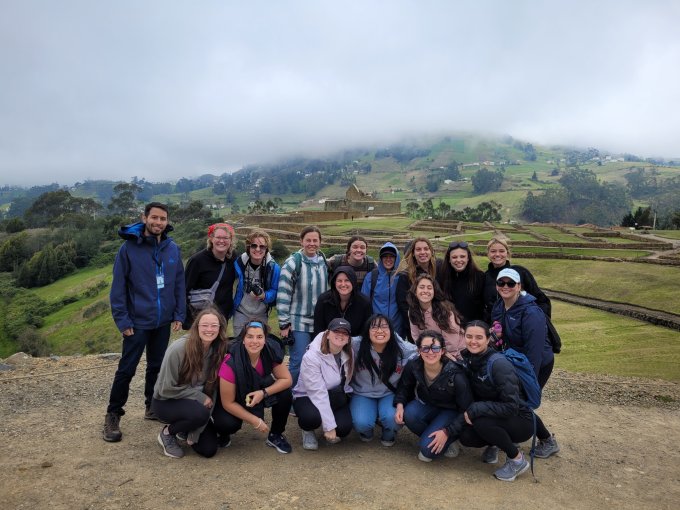
Knowing this complex is a magical experience that will take you on a trip to the past, the structures of Cojitambo are solidly built based on edged blocks of andesite rock, placed one on top of the other forming natural rows, joined with black earth mortar and filled with masonry. All these sets, which are complemented by other evidence of a military and religious nature, are articulated with the Inca trail that passes through the base of the hill, and that in aboriginal times communicated the ancient Tomebamba with the Cañari lordship of Peleusí. The archaeological complex is quite extensive and has constructions with a level of complexity; Due to this, it has been divided into 3 architectural ensembles, based on their spatial distribution and some features that differentiate the sectors from each other: Set I: Which is made up of a large square with a central usnu in the shape of a "U" with round corners open to the east. The walls that make it up are 1.80 meters high by 1.53 meters thick, inside there is a circular water well lined with stone that measures 2.20 meters high by 1.80 meters in diameter. Set II: Which is made up of a large residential terrace, with a retaining wall, and two platforms with retaining walls, and two platforms with retaining walls in the lower part. Complex III: Which is made up of a rectangular structure with two rooms, 6 platforms with retaining walls, 5 housing bases, 4 stairways and a space delimited by a curved wall that covers an area of approximately 682.5 square meters, to the southeast of Square. All these sets of structures and stone foundations cover an area of approximately 25 hectares, on the west side of the hill. In these sets there are: Next to the access road there are three rooms for lodging and administrative activities. A set of several housing and farming terraces that follow each other in a staggered manner from the top to the base of the hill, on the north and west sides. Location Cojitambo Archaeological Complex It is located 11 kilometers west of the city of Azogues, on the western foothills of the eponymous hill, in the Cojitambo parish.
4.61 Km.

The Cojitambo hill is of a multiform type according to the angle from which it is seen: From the north: looks like a sleeping lion From Azogues: looks like a greyhound sitting on its hind legs From the south: it appears gallant and imposing, in a pyramidal shape, like a peak that hurts the blue part of the sky. Precisely because of its morphology, the Cojitambo hill is a perfect natural viewpoint, as it offers a 360-degree panoramic view and at a distance that exceeds 30 kilometers; for which from its top you can appreciate beautiful and varied landscapes. For these reasons, the Cojitambo hill is perfect for photography lovers, as it offers several perfect places to photograph, which is why it attracts professionals and amateurs in this art. Location: The Cojitambo hill is located 11 km west of the City of Azogues, in the Cojitambo parish, of the Azogues Canton. Activities that can be performed: Get to know the Cojitambo Archaeological Complex Knowledge of Cañari - Inca history. Lookout. Contact with the nature. Hiking and camping. The area is free camping. Rappelling and climbing practice. Recreation for children and adults. Photo shooting. To take into account: A guide is not required, but if you are a novice you should go with one for safety. There are hostels in the surrounding areas from 5 to 10 dollars a night.
4.74 Km.

The Museum of the Gastronomy of Cuenca is located in the north exit of the city of Cuenca, in a rural zone but with an accelerated urban development, known as Chaullabamba, aboriginal word that translated means "plain of the fishes". In the museum, the history of the region's cuisine is told, and traditional and typical Andean dishes, fused with international cuisine, can also be eaten. It was founded in April 2019 in the country house of the Urgilés-Cueva family, owners and administrators of the enterprise. The culinary knowledge within the interactive museum, its activity and history are intimately related to tourism and being aware of this aspect the couple Miguel Urgilés and Karen Cueva, who is also a chef, decided to open the Museum. Whoever decides to live this experience will find 2,000 kitchen utensils in the rooms of the house, which were once used by families in the past. The welcome ritual is with a glass of chicha de jora (a drink made of corn and inherited from the Incas) or with the "grandmother's drink" or aromatic water (an infusion made with herbs of the region). A tour of the Museum takes an estimated three hours, which includes the projection of a video and a lot of information about food production, the use of agricultural tools, the sowing-harvesting process and cooking. The collection is organized to celebrate the fusion of the Cañari, Inca and Spanish cultures, which give identity to the current mestizo culture. Visitors have direct contact with each piece in the exhibition, they can touch them, feel them, experience how they were used or what they were used for. A very special room is the "Sala del Uchu" or chili pepper in Kichwa, a native American plant with more than 40 species. The development of the Andean culture is related to the chili. Here the visitor can grind it or "chancar". Another experience is to break "toctes", local fruits similar to nuts.
15.45 Km.

The House Museum of La Macana by José Jiménez is located in Gualaceo, province of Azuay, northeast of Cuenca. The "paños de Gualaceo" or macanas are internationally famous. These cloths are Intangible Cultural Heritage of Ecuador since 2015. Its craftsmen preserve the tradition combining ancient techniques with current sales strategies. That is why Jiménez opened his home to the public more than a decade ago. Fine knotted cloth from Gualaceo was the original name of the garment. But an anecdote tells that back in the 60s of the 20th century, a citizen from Bali, Indonesia, visited the canton. She realized that the weaving technique of the Gualaceo cloth was very similar to the Indonesian ikat technique. She suggested that Gualaceo's weaving should be called by the same name. Since then it has become known throughout the country and abroad. José Jiménez always proudly shows his workshop, his museum, his tools and ways of working to those who visit him. He is an expert in the extraction of colors or natural pigments, which in a liquid state he preserves in ceramic vats. The process of obtaining a cloth begins with the warp. Up to 2,000 cotton threads are separated and the whole is placed lengthwise in a frame to be stretched and tied or knotted with cabuya. At this point the magic begins, because each knotting is a design in itself: birds, insects, popular characters, plants, geographical features. Everything is possible. The knotted threads enter the jars with natural dyes and after drying they go to the waist loom of Cañari origin. A very old machine. Jiménez weaves thread by thread, a framework that can vary in duration, depending on the complexity of the figures. It is a work of much patience. In his museum, Jiménez shows a blue and white mace that belonged to his grandmother a century ago, which was later inherited by his mother and then his wife when they got married. Film actresses and members of European royalty wear his creations. She is the fifth generation in her family to weave cloth. He considers himself the main defender of this wonderful craft in Ecuador. The visit to his workshop costs $1 and the tour lasts half an hour. The macanas are an essential part of the clothing of the famous cholas Cuencanas. They are used daily as well as in special events. In recent years, the macana has been used to design objects: ternos de vestir, shoes, tablecloths, cushions, wallets, scarves, vests. In Gualaceo, there are still about 12 families who weave macanas. Among them are the Orellana and Cárdenas families.
18.49 Km.

Cerro Narrío is one of the most important sites for archaeological research in the south of the country. Several renowned archaeologists, both domestic and foreign, have visited and studied the site. Due to the construction style of the architectural elements and the great variety of cultural materials found in systematic archaeological excavations, it has been determined that the archaeological site of Cerro Narrío was occupied by aboriginal groups, from 2500 BC. C. until 1532 AD. c. This hill was a place of settlement for societies that came from different parts of America 5,000 years ago. C. so it is not ruled out that this culture is one of the oldest in the country. The highlights of Cerro Narrío Ruins Burials: In Narrío the southern and western flanks were used as burial places and many hundreds of graves were found in them. A late grave is made up of a pit 1.50 m deep and 60 to 80 cm wide, within which the body is placed in a flexed position, apparently sitting. Archaeological and Ethnographic Museum of Guantug: This ancestral cultural space, located in the recreation park, Guantug, in the city of Cañar, highlights art, music, customs, dance, agriculture, commerce and fabrics. of the Cañari people. The museum is made up of 6 collections of archaeological pieces, ceramics, stone, shell, bone and metals such as gold and silver. Location The archaeological site of Cerro Narrío is located on the left bank of the Shan-Shan ravine, half a kilometer northwest of the city of Cañar.
19.06 Km.
Browse the tourism services available all over Ecuador.
Find the ideal city for your next trip and discover everything about it.
Find the main tourist attractions in the main cities of Ecuador.