


Ecuador travel
Tourist attractions in Ecuador
Explore the tourist attractions of Ecuador.

Filigree Jewelry in Chordeleg
Shenen Villa filigree is a jewelry workshop located at the entrance of Chordeleg, 100 meters before the first round, sector Cashalao. It treasures the best tradition of the local goldsmith, The artisan Shenen Villa represents the new generation of Chordeleg jewelers in the specialty of filigree or jewelry making with fine gold and silver threads. He learned the trade at a very young age, at 14, in the workshop of his uncle Achilles Villa. Then he set up his own workshop. Today, at the age of 34, he has a gallery and two workshops with machines and staff to make his creations. The making of a filigree jewel starts with the design of the object. Then, the fine metal threads are woven or interwoven with tweezers, until obtaining what is called the filling. At the request of Cristina Hidalgo, Miss Ecuador, the Municipality of Chordeleg commissioned the workshop of Shenen Villa and 8 artisans in the sector, the preparation of 100 pairs of silver candongas of 18 grams, which were delivered to the Miss Universe contestants in Atlanta, Georgia, in December 2019. It took him 5 days to work. A demonstration of the quality and world-wide fame acquired by these Ecuadorian jewels. Villa's specialty is crowns, but he also makes candongas, purses orchids, hummingbirds, necklaces, pendants or under request, whatever the client requests. His workshop also represents the "Route of Beauty", an initiative to promote charming places in Azuay.
305.74 Km.

Amaru Biopark & Wildlife Rescue Center
Interest : Nature Type : Rescue center Friendly to: children, families, seniors Relevant categories: Within Cajas Massif Biosphere Reserve by UNESCO - Wildlife Rescue Center by the Ecuadorian Government Hours : Monday to Friday from 09:00 - 17:00, Saturdays, Sundays and holidays from 10:00 - 17h00 Closed: December 25 The Amaru Biopark (Amaru Bioparque Zoológico Cuenca) is an environmental zoological organization that offers a unique experience of contact with animals and plants that are part of the natural and cultural wealth of Ecuador. The Biopark is located 10 minutes from downtown Cuenca, on the Cuenca - Azogues highway. Through the facilities built in its thematic Biopark, Amaru seeks to inspire people to promote the knowledge and protection of Ecuador's biodiversity. This is done thanks to experiences of direct contact with spectacular rescued animals that can no longer return to their habitat. In Amaru these animals find the space as close as possible to their natural environment. Every year Amaru receives around 450 animals that arrive in different states. Some of them from illegal hunting, illegal trafficking of species, confiscations by the National Police, donations by civilians, etc. Amaru receives all these animals thanks to the fact that they have the only wildlife clinic in the south of the country. Amaru carries out volunteer programs, visits, recreation, education, communication and research in alliance with environmental authorities and organizations, with the support of several public and private institutions and with the participation of local communities. The Biopark can be visited daily. Throughout the several kilometers of Amaru’s trails, you will meet more than 42 species of animals rescued from various regions. From the Andes you will find animals like the Spectacled Bear, Pumas, the Andean Condor, Whitetailed Deer or Black-bellied Eagles. From the Amazon you will find animals such as the impressive Jaguar, Caimans, Macaws, different species of amphibians and monkeys. From the Galapagos Islands you can see animals such as Blue-footed Boobies and Galapagos Turtles. The Biopark has even rescued animals from Africa that were illegally brought to Ecuador, so you can admire the imposing African Lions or the Ostrich. But the best experience Amaru offers is its Volunteer Program, with participants from all over the world. In this program volunteers work in all areas of the Biopark. For example, they spend time in nutrition where they will make diets for all the animals; another time in veterinary where they will have direct contact with the animals collaborating with the veterinarians who work in the park; then, volunteers spend a time in maintenance with the construction personnel where they will carry out work related to the creation of new habitats; later on, in education, volunteers will work directly with the visitors and the educational institutions that visit us. The objective of the volunteering program is to generate, execute and culminate specific projects with each volunteer. These objectives will be assigned from the first day of stay. Volunteering is a unique opportunity to learn about wildlife, environmental education, improve your Spanish and discover the local culture of the city of Cuenca (UNESCO World Heritage Site), once the second capital of the Inca Empire. Source: Fundación Municipal Turismo para Cuenca
306.85 Km.
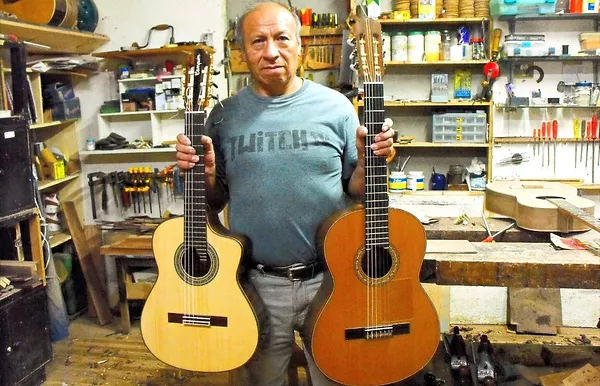
Uyaguari Familiy's Musical Instruments Workshop
A prestigious brand of musical instruments is Uyaguari-Quezada. It has the support of the experience and professionalism of a family of luthiers, which for 4 generations has been dedicated to the construction mainly of the classic guitar. The ancestor of the Uyaguari family comes from the parish of San Bartolomé, "the cradle of guitars", in the canton of Sígsig. The artisan workshop is located in their house, Arquímedes street, Bellavista neighborhood, Cuenca. There, Luis Enrique and Pablo Andrés work together, making beautiful guitars. Pablo is the fourth generation of a family dedicated to the construction of stringed instruments. His father Luis, a craftsman since he was 13 years old, is the third of eight children of Julio Uyaguari, a native of the Sigsillano neighborhood. The "dynasty" would have started with Isidoro Uyaguari, Luis' grandfather. An anecdote tells that one day Isidoro disassembled a guitar to understand how it worked. That moment was the beginning of the family tradition. Art, passion, professionalism, tireless dedication, identity, creativity. These are the opinions of those who have visited the Uyaguari-Quezada workshop, describing their instruments as "authentic wooden jewels", delicate, subtle, moving. Although the Uyaguari specialty is classical guitars, they also make charangos, tiples, bandolas, bandolines. In other words, they are authentic luthiers in the original sense of the word. They use the most noble raw materials: capuli, cypress, teak and walnut. The sound of a guitar is defined by the soundboard. The two craftsmen dedicate more time to this piece, since the perfection of the instrument depends on it. Another skill that only gives the knowledge of the trade is the sensitivity through touch, to judge if a guitar is worth or not. Father and son are music lovers, the result of their work. They love Ecuadorian music, Cuban trova, the new Latin American song and rock. A luthier is a person who builds, adjusts or repairs stringed instruments such as guitars, cuatros or lutes. Today this name is extended to any artisan who repairs musical instruments in general, including wind and percussion instruments. A word of French and Arabic origin, meaning "wood".
306.87 Km.

La Libertad Lookout Tower & Park
The lookout building of 7 floors and 42 meters high is the main attraction of the Parque de la Libertad, Bellavista neighborhood, north of the city of Cuenca. From its top floor there is a 360 degree view of the city. Inaugurated in November 2018, it has become a very busy place, competing in popularity with the Mirador de Turi, the hill of Cullca or the Parque de la Luz. It has an elevator service and a craft shop. It has an attached platform that also serves as a lookout point. In the basement of this pizzeria and ice cream shop services. There are also spaces for conferences and other activities. The Libertad Park has 1.5 hectares of green area decorated with grass, flowers, small trees, a network of paths, a public swimming pool, street furniture and children's games. The Park was located in the former grounds of the former men's prison of Cuenca and of the Municipality's warehouses. The designation "La Libertad" was due to its opposition to the situation of confinement that the people of the old prison were living in. The prison building was transformed into a citizen service center with a pharmacy, a municipal payment window, bank tellers, a restaurant, a movie theater, an audio room, an internet room, a games and reading room, and public bathrooms.
307.00 Km.

La Merced Piazza & Traditional Neighborhood
The Piazza de La Merced is a small esplanade of 1,500 m2. It is the center of an intense social life, especially at night, in the Historical Center of Cuenca, a city declared a World Heritage Site by UNESCO. The square is delimited by the streets Borrero, Honorato Vásquez and Calle Larga. But the neighborhood, of the same name, also keeps a lot of history. The piazza is a space adapted for pedestrians and bicycles. All kinds of cultural, social and artistic activities can be carried out there. It is a space for recreation and meeting of citizens. It has good lighting at night. The piazza preserves several examples of heritage trees, including a poplar and several jacarandas that, when they bloom between September and November, fill it with color. A statue of the priest Julio Maria Matovelle dominates the center of the piazza. This famous priest was a teacher, lawyer, literati, historian, politician and founder of the Congregation of the Oblate Mothers of the Sacred Heart of Jesus and Mary. The construction of the small square began around 1850, as did the church. The La Merced neighborhood is traditionally a sector of workers with a strong religious character. However, today the nightlife is intense in La Merced due to the development of activities such as offices, bars, restaurants, discos and hotels. The Remigio Crespo Toral Museum, the La Merced Church, the old house of the Workers Alliance, the Santísima Virgen del Río Chapel, the Julio María Matovelle Educational Unit, and the Abraham Lincoln Cultural Center are all located in the vicinity.
307.09 Km.

Homero Ortega Toquilla Straw Hat Factory
Homero Ortega is the brand name of an important producer of hats and other toquilla straw articles in the city of Cuenca. For 120 years and five generations, the Ortega family has given continuity to this economic activity, making it the oldest and most experienced organization in the export of straw hats. In 2012 UNESCO inscribed the Traditional Ecuadorian Toquilla Straw Hat Weaving Technique on the list of Intangible World Cultural Heritage. The factory has been based, since its creation until today, in the urban parish of El Vecino, in the city of Cuenca. Homero Ortega is its founder, linked to this work since he was a child. He learned the business from his father Aurelio Ortega García. In the beginning, together they ventured through the dangerous route of "El Cajas" to Guayaquil. In the port they sold hats to merchants who took them to Panama on ships. During the 20th century, the company consolidates and grows. Its success is based on the capacity to adapt to the different scenarios of the world market, to the conception of the toquilla straw hat as a manifestation of the popularity and the production with quality. An outstanding element of Homero Ortega is the Museum "The Magic of the Hat", open to the public since 2008. It was the concretion of a project of public diffusion of the history of the toquilla straw hat as a handmade product in Ecuador. The Museum has three rooms: the history of the hat, its elaboration and the trajectory of the company. Visitors enjoy an interactive experience. One of the most photographed and recognized prints is the toquillera artisan that demonstrates how the hat is woven. The Museum is a member of ICOM, a UNESCO partner institution. Some historical data of the permanent exhibition of the Museum are the following: the Azuayan businessman Bartolomé Serrano had the initiative to teach the hat weaving to the artisans of Azuay and Cañar in 1835, through weavers of the city of Montecristi, to face a strong economic crisis; the toquilla straw hat was the number one export product of Ecuador between 1944 and 1946; the first exports took place in the middle of the XIX century from Manabí; from Cuenca the exports began in 1890.
307.13 Km.

Municipal Economuseum "Casa del Sombrero"
The Municipal Economuseum "Casa del Sombrero" has four permanent exhibition rooms where visitors can appreciate the art of weaving the toquilla straw hat through videos, photographic representations, objects and materials used over time for this artisan work , practiced since pre-Columbian times. It has two exhibition rooms and sales of hats and articles made of toquilla straw.
307.30 Km.

House of the Toquilla Straw Hat
A walk through the workshops and museums of the toquilla straw hat, curiously worldwide known as "Panama Hat", will make you discover that in fact it is original from and elaborated in Ecuador. One of the regions where it is woven is in the Ecuadorian Southern Andes, in the provinces of Azuay and Cañar. On December the 5th, 2012 UNESCO declared the traditional knitting of the toquilla straw hat as Intangible World Heritage. In order to recover the historical memory of this handicraft the Municipal Museum-Workshop “Casa del Sombrero” (House of the Hat) was inaugurated in 2014, in the city of Cuenca. It is located is in an old and emblematic house that functioned as a factory of hats. The initiative is public and free to enter. The elaboration of the hat was the economic foundation of the Ecuadorian population, especially in the south of the country, during the 20th century. Private initiatives also contribute to keep spaces where the story of the Toquilla straw hat is told. The first is the “Hat Museum” of the Paredes Roldán family (Calle Larga and Padre Aguirre, Historic Center, Cuenca, Ecuador). The factory continues operating on the site and the visitor can buy a custom-made hat. The second space is the Museum “La Magia del Sombrero” of the Homero Ortega company (Avenida Gil Ramirez Davalos 3-86, behind the Land Terminal, Cuenca, Ecuador). In 1830 the hats were commercialized in Panama. The Ecuadorian hat gained popularity because of being: resistant, light weighted, foldable for storage, combinable with light summer clothing and because of allowing sweat to evaporate. When the Panama Canal was constructed the workers used it and in 1903 a photograph of the President of the United States, Teddy Roosevelt, wearing this hat during a visit to the canal was widely publicized, which gave rise to the name of “Panama hat”. All this history and industry is based on the work of thousands of artisans and weavers who live in the small towns near Cuenca, such as Chordeleg, Gualaceo, Sígsig, Azogues and Biblián. The hat is also known as the “Jipijapa hat” or “Montecristi hat”, towns at the Ecuadorian Pacific coast that were the original centers of its elaboration.
307.32 Km.

Ancestral Pottery Workshop by Encalada & Sons
Interest:Culture Type : Manufacturing Industry Friendly with: children, families, seniors, disabled Relevant categories: Historic Center of Cuenca, Cultural Heritage of Humanity UNESCO - Within the Macizo del Cajas Biosphere Reserve UNESCO - Within Cuenca, National Cultural Heritage of Ecuador Hours : Monday to Sunday 08:00 - 18:00. Variable hours on holidays. The Ivan Encalada Pottery Workshop is the heritage of a pottery tradition that is located in the district of La Convención del 45, a typical place in Cuenca (Ecuador) for its craftsmen dedicated to pottery. The tradition was started in 1962 by his father José Encalada, when he opened the business that has always been located in Mariscal Lamar Street, in the family's house. José started his pottery apprenticeship in 1948. His teachers were Juan Arias and Miguel Pacheco. He needed to learn a trade to make a living. His son Ivan has become, over the years, his best student and assistant. The Encalada family home is also a centre for displaying the products and works of Ivan and Jose, utilitarian objects such as jugs, glasses, plates and pots or pieces of undeniable artistic value. It is also a museum-workshop to observe first-hand the work of the master potters on a standing lathe or to learn the elaboration of ceramics by means of the ancestral "black" technique, of millenary Cañari (a pre-Inca culture) roots. For José Encalada, the support of all his family has been important for the maintenance of the workshop. His wife Yolanda Arias and his daughters and sons have taken part in this project. Father and son are constantly concerned about the fate of the trade. That is why they have thought it convenient to teach the public the process of producing a ceramic object. On the other hand, they have had the initiative and have participated in organizational processes and in the aggregation of the potters of the neighborhood, with the foundation of the Guild of Potters and Ceramists, with the objective that this activity is not lost. Another space that gives identity to the sector is the Casa del Alfarero, managed by the Municipality of Cuenca as a Cultural Center and a place for community meetings and the people of the neighborhood. The neighborhood of The Convention of '45 was created during the course of the 19th century, as an artisan's neighborhood. It was one of the multiple dismemberments of San Sebastian, one of the 3 great parishes that Cuenca had after its foundation, besides El Sagrario and San Blas.
307.62 Km.

Rotary Square
Cuenca stands out for our variety and quality of handicrafts. Rotary Square is a traditional place where you can buy countless forms of handcrafted items. For many years, Cuencanos have acquired their household items here: furniture, ceramics (flowerpots, vases, crockery), wrought iron (crosses, agricultural tools, plant stands), natural fibers (baskets, fans, etc...).
307.71 Km.

Joyería Cuencana Museum
The museum displays materials and tools for the jewelry work. It is located in a cultural heritage property. The craftsman in charge performs live demonstrations of the process as well as allows the visitor to interact and be part of the making process
307.89 Km.

Jewelry Street in Cuenca
Gran Colombia Street is the center of a dynamic commercial, artisan and cultural activity in the city of Cuenca. Known as the "Jewelry Street", it is also home to a museum dedicated to the work of the goldsmiths In a few blocks, you can find shops selling ceramics, clothing, embroidery, leather goods, and crafts in general. The jewel in the crown are the enterprises dedicated to the design, elaboration and commercialization of jewelry. In just two blocks and in a few minutes, it is possible to visit at least 10 jewelry stores with objects of the highest quality made by Cuenca craftsmen. And in the surroundings there are other 10 additional points of sale. To get an overview of this artisan work, one option is to visit the Museo de la Joyería Cuencana. It has a section that recognizes the trajectory of outstanding jewelers of the city. Another section exhibits tools and techniques used by the goldsmiths. In the workshop you can appreciate the process of elaboration of the jewels. The circuit is completed with the exhibition and sale of finished products. The city's jewelers are organized in an Association, which brings together about 50 artisans. In Azuay and Cuenca, the history of jewelry making goes back thousands of years. It is a heritage of the Cañari culture. In the pre-Inca period, the notions of art were established. The Cañari tradition was fused with the knowledge of the precious metals of the Incas. Later, during three centuries, the ancestral practices were mixed with what the Spaniards knew and their methods of extraction and production. The "Calle de las Joyerías" is currently the best showcase to observe the progress and development of this Cuenca craft. Foreign techniques have allowed the industrialization of the processes. The small artisan workshops have adapted to this change. The Great Colombia, named after the ephemeral unit created by Simon Bolivar, must be walked slowly. The objective: to pay attention to details. The architecture of their houses. The options open in their shops. Today it is the backbone of the Cuenca Tramway.
307.91 Km.
We have 413 tourist attractions listed in Ecuador.