

Tour Operators

Tourist attractions in Ecuador
 BuenTrip Travel APP
Address:
Parroquia de TuriTourism businesses within 30 km.
Places to visit within 30 km.
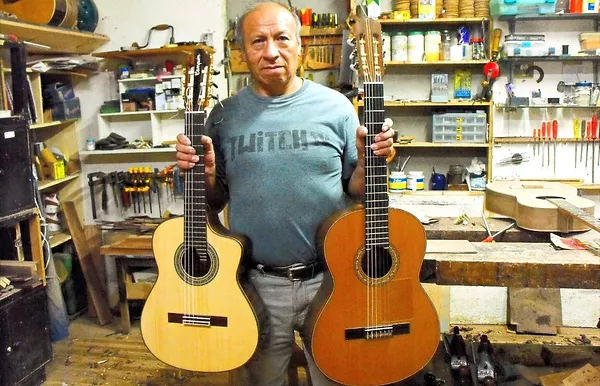
A prestigious brand of musical instruments is Uyaguari-Quezada. It has the support of the experience and professionalism of a family of luthiers, which for 4 generations has been dedicated to the construction mainly of the classic guitar. The ancestor of the Uyaguari family comes from the parish of San Bartolomé, "the cradle of guitars", in the canton of Sígsig. The artisan workshop is located in their house, Arquímedes street, Bellavista neighborhood, Cuenca. There, Luis Enrique and Pablo Andrés work together, making beautiful guitars. Pablo is the fourth generation of a family dedicated to the construction of stringed instruments. His father Luis, a craftsman since he was 13 years old, is the third of eight children of Julio Uyaguari, a native of the Sigsillano neighborhood. The "dynasty" would have started with Isidoro Uyaguari, Luis' grandfather. An anecdote tells that one day Isidoro disassembled a guitar to understand how it worked. That moment was the beginning of the family tradition. Art, passion, professionalism, tireless dedication, identity, creativity. These are the opinions of those who have visited the Uyaguari-Quezada workshop, describing their instruments as "authentic wooden jewels", delicate, subtle, moving. Although the Uyaguari specialty is classical guitars, they also make charangos, tiples, bandolas, bandolines. In other words, they are authentic luthiers in the original sense of the word. They use the most noble raw materials: capuli, cypress, teak and walnut. The sound of a guitar is defined by the soundboard. The two craftsmen dedicate more time to this piece, since the perfection of the instrument depends on it. Another skill that only gives the knowledge of the trade is the sensitivity through touch, to judge if a guitar is worth or not. Father and son are music lovers, the result of their work. They love Ecuadorian music, Cuban trova, the new Latin American song and rock. A luthier is a person who builds, adjusts or repairs stringed instruments such as guitars, cuatros or lutes. Today this name is extended to any artisan who repairs musical instruments in general, including wind and percussion instruments. A word of French and Arabic origin, meaning "wood".
6.48 Km.

The lookout building of 7 floors and 42 meters high is the main attraction of the Parque de la Libertad, Bellavista neighborhood, north of the city of Cuenca. From its top floor there is a 360 degree view of the city. Inaugurated in November 2018, it has become a very busy place, competing in popularity with the Mirador de Turi, the hill of Cullca or the Parque de la Luz. It has an elevator service and a craft shop. It has an attached platform that also serves as a lookout point. In the basement of this pizzeria and ice cream shop services. There are also spaces for conferences and other activities. The Libertad Park has 1.5 hectares of green area decorated with grass, flowers, small trees, a network of paths, a public swimming pool, street furniture and children's games. The Park was located in the former grounds of the former men's prison of Cuenca and of the Municipality's warehouses. The designation "La Libertad" was due to its opposition to the situation of confinement that the people of the old prison were living in. The prison building was transformed into a citizen service center with a pharmacy, a municipal payment window, bank tellers, a restaurant, a movie theater, an audio room, an internet room, a games and reading room, and public bathrooms.
6.73 Km.

Interest:Culture Type : Manufacturing Industry Friendly with: children, families, seniors, disabled Relevant categories: Historic Center of Cuenca, Cultural Heritage of Humanity UNESCO - Within the Macizo del Cajas Biosphere Reserve UNESCO - Within Cuenca, National Cultural Heritage of Ecuador Hours : Monday to Sunday 08:00 - 18:00. Variable hours on holidays. The Ivan Encalada Pottery Workshop is the heritage of a pottery tradition that is located in the district of La Convención del 45, a typical place in Cuenca (Ecuador) for its craftsmen dedicated to pottery. The tradition was started in 1962 by his father José Encalada, when he opened the business that has always been located in Mariscal Lamar Street, in the family's house. José started his pottery apprenticeship in 1948. His teachers were Juan Arias and Miguel Pacheco. He needed to learn a trade to make a living. His son Ivan has become, over the years, his best student and assistant. The Encalada family home is also a centre for displaying the products and works of Ivan and Jose, utilitarian objects such as jugs, glasses, plates and pots or pieces of undeniable artistic value. It is also a museum-workshop to observe first-hand the work of the master potters on a standing lathe or to learn the elaboration of ceramics by means of the ancestral "black" technique, of millenary Cañari (a pre-Inca culture) roots. For José Encalada, the support of all his family has been important for the maintenance of the workshop. His wife Yolanda Arias and his daughters and sons have taken part in this project. Father and son are constantly concerned about the fate of the trade. That is why they have thought it convenient to teach the public the process of producing a ceramic object. On the other hand, they have had the initiative and have participated in organizational processes and in the aggregation of the potters of the neighborhood, with the foundation of the Guild of Potters and Ceramists, with the objective that this activity is not lost. Another space that gives identity to the sector is the Casa del Alfarero, managed by the Municipality of Cuenca as a Cultural Center and a place for community meetings and the people of the neighborhood. The neighborhood of The Convention of '45 was created during the course of the 19th century, as an artisan's neighborhood. It was one of the multiple dismemberments of San Sebastian, one of the 3 great parishes that Cuenca had after its foundation, besides El Sagrario and San Blas.
6.88 Km.

The Tomebamba River Ravine is the natural southern limit of the Historic Center of Cuenca (Cultural World Heritage Site by UNESCO). The ravine is part of a bio-corridor with unique characteristics that crosses the city. In this place, history and culture are united with the landscape and architecture. The Viceroy Andrés Hurtado de Mendoza ordered, in the middle of the 16th century, that the city of Cuenca be founded with the same name as his hometown in Spain. At present, both cities are sisters and both have a ravine with similar qualities. The Tomebamba’s Ravine has an extension of two kilometers. It begins in the Vado neighborhood and ends in the Pumapungo Museum and Archaeological Park. It is possible to walk along the Ravine in an integral way, by any of the two margins of the river. But along the margin of Paseo Tres de Noviembre, you can also travel the ravine by bicycle. Points of interest in the Tomebamba’s Ravine, for postcard photos, along the way are: the Casa de los Arcos, the descent of the Centenario Bridge, the Ordóñez family house, the old Hotel Crespo, the Remigio Crespo Museum, the CIDAP (Interamerican Center of Popular Arts), the stairs of the Parque de la Madre, the church and neighborhood of Todos Santos, the Broken Bridge and the Pumapungo Museum and Archaeological Park. Through several pedestrian and vehicle bridges, the historic city on the side of the Tomebamba River Ravine, is linked to the new city on the other side of the Tomebamba River. A relatively recent place is the Alameda 12 de Abril, a tree-lined walk that allows one to observe and photograph the Tomebamba River Ravine from a greater perspective, while walking between the Centenario Bridge and the Todos Santos Bridge. A romantic myth idealizes the Tomebamba River Ravine. There is a belief that its landscape and nature are an inspiration for poets, musicians, photographers, lovers and visitors. But without a doubt those who enjoy walking it, marvel at its hanging houses, the abundance of birds and the diversity of species of trees and plants. It also attracts the tranquility provided by the sound of the waters of the Tomebamba River. Today it is possible to stop the walk and enter one of the bars or restaurants open in the area to enjoy excellent food, a refreshing drink and beautiful panoramic views of the new city. The Barranco is a must see in Cuenca. It allows the realization of sports, artistic or outdoor activities. During the 70's and 80's of the 20th century a trade was developed in the Tomebamba River Ravine, the washerwomen. Women who went down to the riverbank to wash clothes. Another typical activity that was lost due to the over exploitation of the resource, is fishing. Decades ago, during the season, the people of the valley would come down by the thousands to the ravine to collect fish from the river waters. The Tomebamba river is the city's main water resource. It is born in the lagoons of the Cajas National Park, a source of drinking water. The Tomebamba River is a tributary of the Paute River where, downstream, in the middle of the Eastern Andes, the largest hydroelectric dam in Ecuador operates.
6.99 Km.

With 31 years of experience and a solid position in the international market, the Center of Embroidery Cuenca brings together dozens of craftswomen. Their products are handmade with natural fibers. Winner of the UNESCO Crafts Prize of Excellence 2014. The crafts of this cooperative created in Cuenca in 1989 are exclusive. They were 132 the founders of 11 rural communities of Cuenca, Paute and Gualaceo. It is an organization of Popular and Solidarity Economy (EPS), with the departments of design, technical area, production and administration. Its members believe in equitable development for all. They compete nationally and internationally by offering a variety of quality artistic products. The natural fibers with which they work are cotton, alpaca wool, toquilla straw, with a mixture of embroidery and fabrics. Among their works, the production of clothes such as T-shirts, blouses or dresses stands out. For the home they make table linen, napkins, rugs, bread and wine makers. They have a production line of duvets filled with alpaca wool. Toquilla straw hats and cards. It distributes to different points of the capital of the Azuay, to Quito and Guayaquil. It has clients in Austria, Switzerland, Spain, Chile, Japan, the United States and Canada. The Center protects the art of hand embroidery. To be born in 1989, they received the support of the Swiss Agency for Development and Cooperation (SDC) and the Ecuadorian Fund for the Development of the People (FEPP). During these decades of work it has achieved the organization of women, control of intermediaries, training and a better level of income. The members of the cooperative strive to provide full customer satisfaction under strict quality standards and by putting maximum dedication into their embroidery. The Centre has a website with an online shopping function and digital catalogue.
7.00 Km.

The Municipal Economuseum "Casa del Sombrero" has four permanent exhibition rooms where visitors can appreciate the art of weaving the toquilla straw hat through videos, photographic representations, objects and materials used over time for this artisan work , practiced since pre-Columbian times. It has two exhibition rooms and sales of hats and articles made of toquilla straw.
7.28 Km.
Browse the tourism services available all over Ecuador.
Find the ideal city for your next trip and discover everything about it.
Find the main tourist attractions in the main cities of Ecuador.